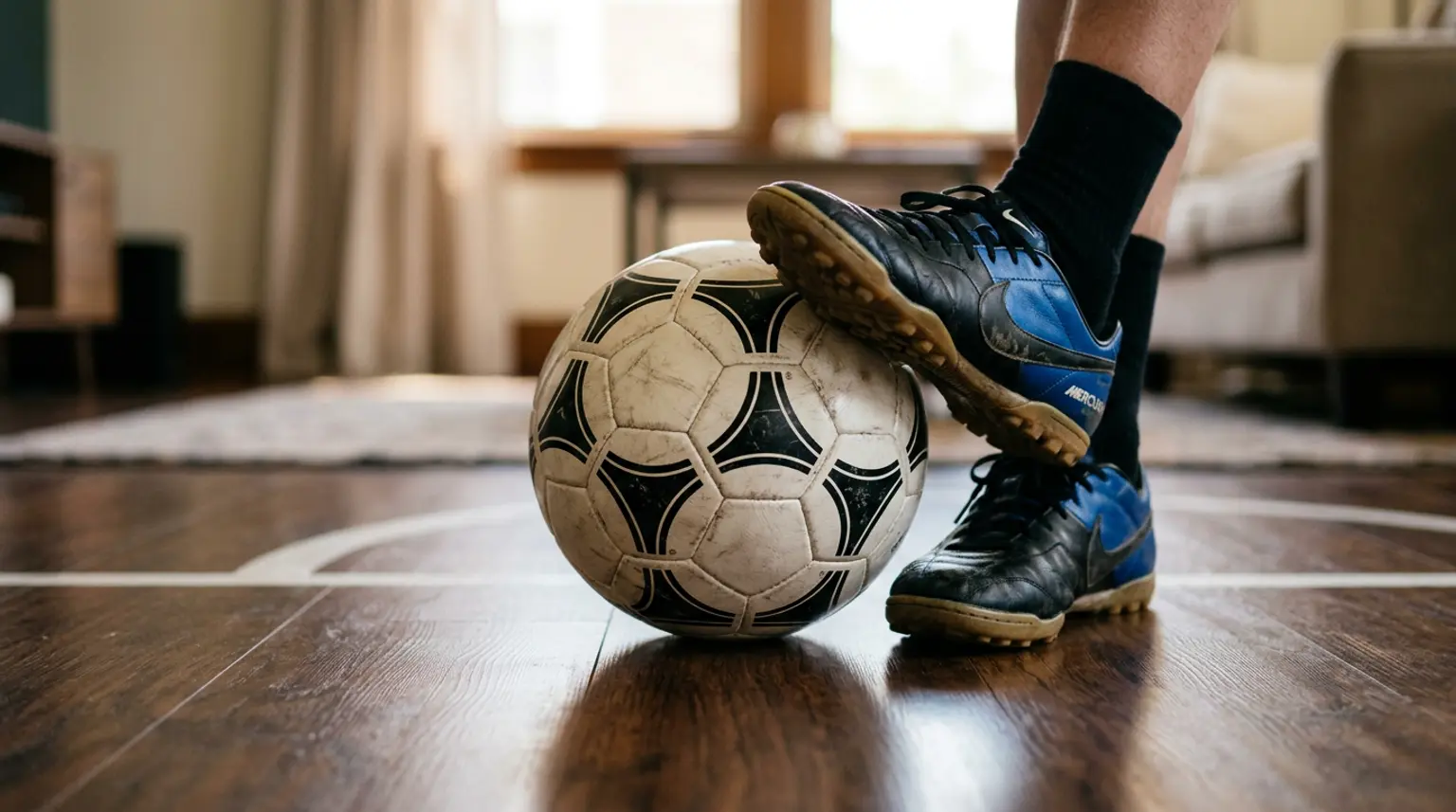
Soccer Footwork Drills You Can Do in a Small Space
 Reviewed by Roman PivarnikUEFA Pro Licence · Technical Director, Slovak FA
Soccer footwork drills improve a player's ability to control the ball in tight spaces, change direction quickly, and execute moves at game speed, and most of them can be done in a space as small as 2 by 2 meters. The best footwork drills for youth soccer players require nothing more than a ball and a flat surface. No cones, no field, no partner. A living room, garage, or small patch of driveway is enough. Players who dedicate 10 to 15 minutes per day to footwork drills see noticeable improvement in close control and confidence within 2 to 3 weeks.
Footwork is what separates players who look comfortable on the ball from those who do not. It is the ability to manipulate the ball quickly and precisely using all surfaces of the foot: sole, inside, outside, and laces. Good footwork makes everything else in soccer easier: dribbling, receiving, turning, and beating defenders.
Why is footwork important for soccer players?
In a game, the average youth player has 1 to 2 seconds on the ball before a defender closes them down. Players with strong footwork can control, turn, and release the ball within that window. Players with weak footwork lose possession.
Footwork is trainable. It is not a talent some players are born with. It is a skill built through repetition. The exercises below, performed daily, build the neural pathways that make quick, precise foot movements automatic.
What are the best footwork drills for a small space?
These drills require minimal space and can be performed standing in one spot or moving within a 2 by 2 meter area.
Foundation footwork (suitable for all ages)
Toe taps. Alternating tapping the top of the ball with the sole of each foot at a steady rhythm. This is the simplest footwork exercise and builds basic coordination and foot speed. Start slow and increase speed as comfort improves.
Sole rolls (right and left foot). Rolling the ball side to side under the sole of one foot. This develops touch sensitivity and teaches players to feel the ball without looking down. Practice on each foot separately to build bilateral control.
Inside touches. Quick side-to-side touches using the inside of both feet. The ball moves laterally while the player stays in place. This builds the rhythm and coordination needed for tight-space dribbling.
Side-to-side inside touches. A variation where the player moves laterally with the ball using alternating inside touches. Develops the ability to shift position while maintaining close ball control.
Intermediate footwork (ages 10 and up)
V-cuts (right and left foot). Pull the ball back with the sole and push it forward at an angle with the inside of the foot. The ball traces a V-shape on the ground. This develops the ability to change direction quickly, one of the most important footwork skills in games.
V-cuts with inside push. The same pull-back motion, but the push goes to the inside using both feet. Adds complexity by requiring quick weight transfer between feet.
V-cuts with outside push. Pull back with the sole, push forward with the outside of the foot. This develops the outside-of-foot control used for beating defenders on the dribble.
Outside U's. The player hooks the ball in a U-shaped arc using the outside of the foot. Builds the curved ball manipulation used for turns and direction changes.
Roll U's. Similar to outside U's but using a rolling motion under the sole. Develops the smooth, fluid ball movement that characterizes technically strong players.
3-angle push-pull. Pushing and pulling the ball at three different angles using alternating feet. This multi-directional exercise builds the ability to manipulate the ball in any direction.
Advanced footwork (ages 12 and up)
L-drags (right and left foot). Drag the ball back with the sole and push it sideways with the inside of the foot, creating an L-shaped pattern. Requires precise timing and bilateral coordination.
No-touch step overs. Performing step-over motions around the ball without touching it. Builds the deceptive body movements used to unbalance defenders in 1v1 situations.
Inside touch step overs. Combining an inside touch with a step-over in one continuous motion. This is a game-relevant combination move used to change direction while selling a fake to the defender.
Sole rake stops (alternating). Pulling the ball to a dead stop with the sole before pushing it out again. Develops the ability to change pace instantly, which is one of the most effective ways to beat a defender.
Alternating roll outside snaps. Rolling the ball across the body and snapping it back with the outside of the opposite foot. An advanced coordination exercise that builds the bilateral control needed for high-level play.
Roll chops. Rolling the ball across the body and chopping it back with the inside of the opposite foot. A complex combination move that challenges even experienced players.
FlickTec's library includes over 40 footwork and ball mastery exercises organized from beginner (level 1) to advanced (level 3), each with video demonstrations from Coach Roman Pivarnik (UEFA Pro Licence, 25+ years at the highest European levels). The app progresses players through difficulty levels automatically.
How should a footwork session be structured?
A focused footwork session takes 15 to 20 minutes:
Warm-up (3 minutes). High knees, butt kicks, forward kicks, and hamstring sweeps to activate the leg muscles and raise body temperature.
Footwork block (10 to 12 minutes). Choose 6 to 8 exercises. Perform each for 45 to 60 seconds, focusing on clean execution before increasing speed. Alternate between right foot, left foot, and both feet exercises.
Cool-down (3 minutes). Static stretching targeting the calf muscles (sit back on toes, calf stretch), quadriceps (couch stretch, sit back on heels), and hamstrings (seated hamstring stretch, wide-leg hamstring stretch).
How do footwork drills transfer to game situations?
Every footwork exercise builds specific game-relevant capabilities:
Toe taps and sole rolls build the comfort with the ball that allows a player to receive under pressure without panicking.
V-cuts translate directly to changing direction while dribbling, one of the most common actions in a match.
Step overs and L-drags develop the moves used to beat a defender in a 1v1 situation.
Inside touches and outside-inside patterns build the close control used for navigating through midfield congestion.
The key is volume. A player who performs 500 V-cuts in a week will execute them in a game without thinking. A player who performs 50 will still be thinking about the mechanics instead of the game.
How do footwork drills compare to dribbling drills?
Footwork drills are typically stationary or involve minimal movement. They focus on the player's relationship with the ball: touch, control, and foot speed. Dribbling drills add locomotion: the player moves through space with the ball, navigating around obstacles or along patterns.
Think of footwork as the foundation and dribbling as the application. A player with strong footwork will learn dribbling patterns faster because the underlying ball manipulation skills are already in place.
For players ready to add dribbling to their home training, exercises like inside-outside dribbling, sole outside dribbling, continuous inside dribbling, and speed circles (dribbling around a cone at maximum speed) are excellent next steps.
Frequently Asked Questions
How much space do footwork drills require?
Most footwork drills can be done in a 2 by 2 meter space. Exercises like toe taps, sole rolls, V-cuts, and inside touches are performed standing in one spot. A living room with the furniture pushed aside, a garage, or a small section of driveway is more than enough.
Can footwork drills be done indoors?
Yes. Most footwork exercises involve soft, controlled touches that do not send the ball flying. Use a slightly deflated ball indoors to reduce bounce. The exercises are designed for close control, so there is minimal risk of hitting furniture or walls.
How often should kids practice footwork?
Daily practice of 10 to 15 minutes produces the fastest results. If daily is not possible, 4 to 5 sessions per week is still highly effective. The key is consistency over duration. 10 minutes every day beats 60 minutes once a week.
Should players practice footwork with both feet?
Absolutely. Bilateral foot development is one of the most important goals in youth soccer. Practice every exercise with both the right and left foot. FlickTec includes left and right foot variations for exercises where bilateral practice matters.
At what age should kids start footwork drills?
Kids as young as 6 can start with simple exercises like toe taps and sole rolls. By age 9 or 10, players can handle V-cuts and inside touches. By age 12, more complex exercises like L-drags, step overs, and roll chops become appropriate.
Footwork is the foundation of every technical skill in soccer. The drills are simple, they require almost no space, and they produce results that transfer directly to games. 10 to 15 minutes a day, every day, with a ball at your feet.
FlickTec provides progressive footwork training from beginner to advanced with 500+ video-guided exercises. Start training at flicktec.io/players.